Section 1
A general overview of Hirevue AI
Navigating AI in Hiring: A Reference for Enterprise Teams

This guide fosters a spirit of transparency around AI usage, risk and readiness for HR, legal and IT users. With the rise of AI council reviews, AI addendums, and procurement questionnaires during HR technology consideration, enterprise buyers increasingly require structured AI documentation before approving any AI tool used in their hiring process. This guide provides the answers, the context, and the support to move those conversations forward.

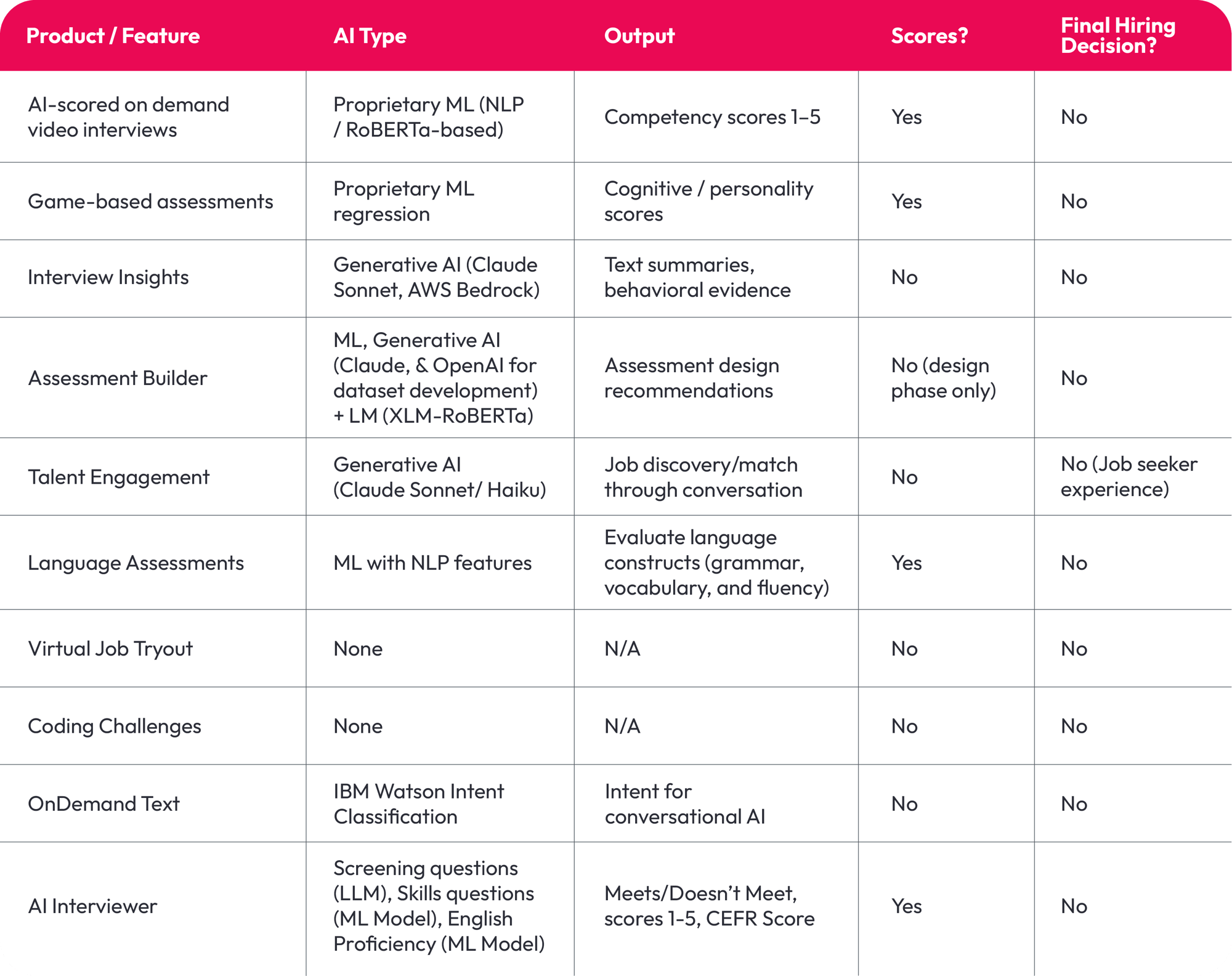
Scores from AI-scored interviews and game-based assessments are inputs to employer decision-making. Whether they constitute AEDTs depends on how the employer configures and uses them. If scores are used as the primary or most significant criterion in a selection decision, CA FEHA or NYC LL 144 may apply and the Customer should coordinate with their own legal department for a legal analysis (we can provide general guidance but cannot give customers legal advice). For more details, reference AI in Hirevue Products.
The Human + AI Balance
Hirevue is a decision intelligence platform, not a decision-making system. Scores are inputs — the recruiter/hiring manager/employer always makes the final call. Key implications:

AI-Scored Interviews
2.1 The Three-Stage Interview Scoring Pipeline
AI-scored interviews follow three sequential stages:
As illustrated here, Hirevue's AI-scored interview models analyze only the transcribed text of what candidates say in their interview responses. Other Hirevue AI products evaluate different inputs — for example, game-based assessments analyze gameplay behavior, and AI Interviewer's English proficiency scoring evaluates spoken-language features such as fluency and pronunciation. For AI-scored interviews, the models do not analyze or consider:
2.2 Training Data Diversity (AI Scored Interview Models)
Hirevue's scoring models are trained on data collected from diverse populations. The most recent rater study sample includes:
This demographic representation is not accidental — it is a deliberate design requirement for bias testing and mitigation.
2.3 Bias Mitigation — How It Actually Works
Hirevue applies bias mitigation, fairness, and quality controls based on each AI system’s intended use, output, and level of decision influence. Because Hirevue AI products serve different purposes — for example, scoring candidate assessment responses, summarizing interview evidence, recommending assessment content, or supporting candidate engagement — the relevant controls vary by product.
For assistive or generative AI features that do not generate candidate selection scores — such as Interview Insights, Talent Engagement, or assessment design recommendations — fairness controls focus on appropriate use, grounding outputs in relevant source data, reducing unsupported or inappropriate outputs, maintaining human oversight, protecting candidate privacy, and monitoring quality and reliability. These systems are not intended to replace recruiter or hiring manager judgment or make final hiring decisions.
For AI systems that generate candidate scores used in assessment workflows, Hirevue employs a multi-layered approach to bias mitigation:
Hirevue employs a multi-layered approach to bias mitigation across AI Scored Interviews:
2.4 Third-Party AI Components (Across Platform)
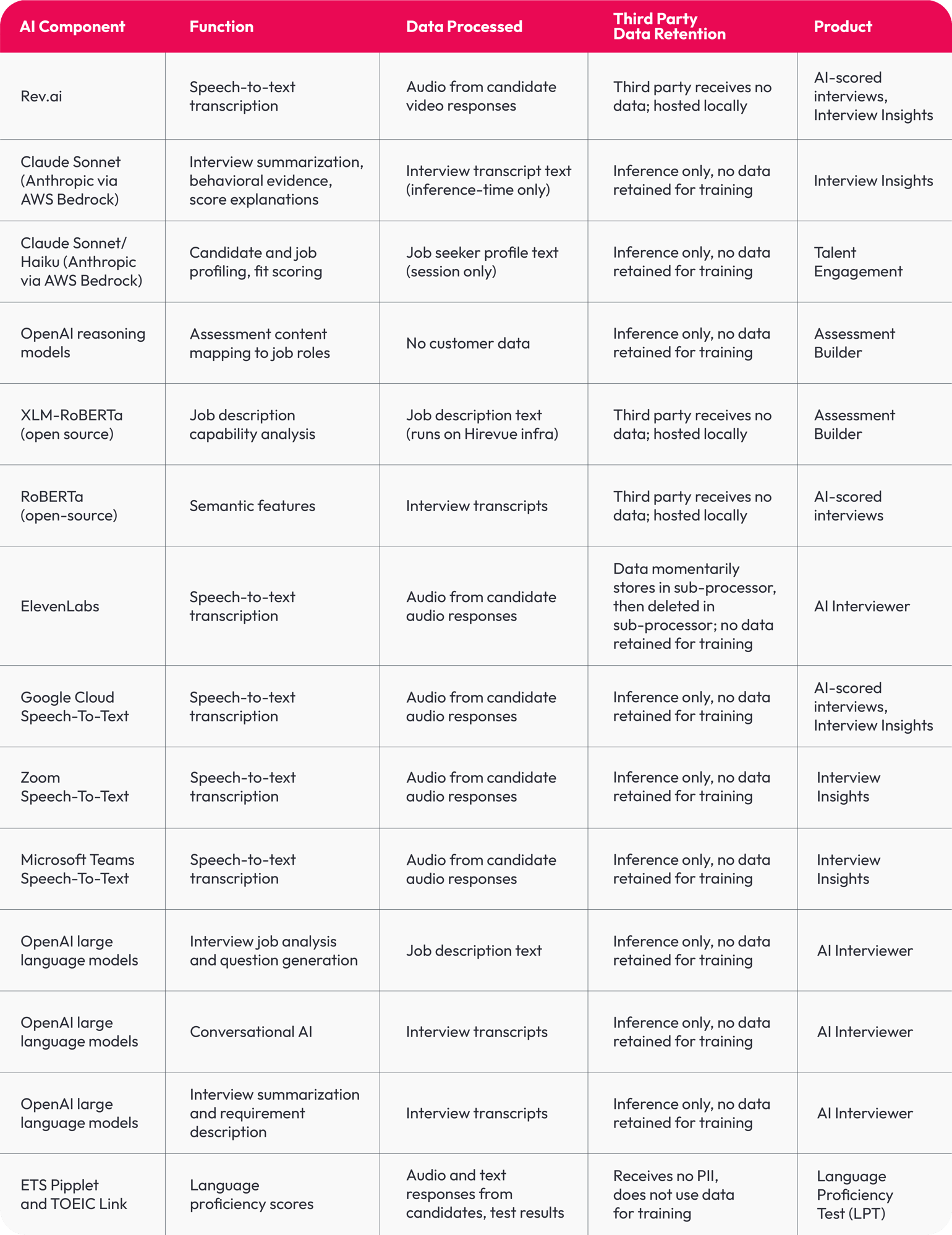
Enterprise addendums frequently ask for a complete list of AI components, the table below provides a clean, audit-ready answer.
2.5 Model Updates and Monitoring (Across Platform)
Hirevue AI systems are reviewed and monitored based on their intended use, output, and risk profile. Depending on the product, monitoring may include evaluation of model performance, output quality, fairness outcomes, operational reliability, compliance requirements, and appropriate use.
Hirevue may update AI models or AI-enabled capabilities when there is a clear reason to do so, such as advances in data science or IO psychology, new technologies or model capabilities, new role requirements or competencies, accumulated validation evidence, customer feedback, changes in product functionality, monitoring results indicating an opportunity for improvement, or changes in the availability or support status of third-party model versions.
For Hirevue assessment solutions that generate candidate scores, monitoring may include:
For scored assessment models, Hirevue does not update models that impact candidate scoring without customer consultation. Updates are managed through controlled governance, documentation, testing, and deployment processes designed to support fairness, consistency, auditability, and traceability.
When anomalies or performance concerns are identified, corrective actions are managed through established governance and incident response processes. Depending on the issue and product involved, this may include investigation and escalation, customer communication, pausing scoring where warranted, and rescoring or reprocessing with corrected models when appropriate.
Candidate and assessment data are retained in accordance with customer-defined retention settings, contractual requirements, and solution configuration, and may support auditability, validation, model improvement, anomaly investigation, and rescoring or reprocessing where permitted.

No. Hirevue provides structured, job-relevant information to support human decision-making; it does not replace recruiter or hiring manager judgment. Recruiters and hiring teams continue to define evaluation criteria, configure workflows and thresholds, review candidate information, determine how results are used, and make final hiring decisions. Different Hirevue AI products support different parts of the hiring process. For example, AI-scored assessments provide competency or assessment scores, Interview Insights can help summarize interview evidence, Assessment Builder can recommend job-relevant assessment content, and Talent Engagement can support candidate interaction and job discovery. These tools help improve consistency, efficiency, and scale, allowing hiring teams to focus their time on candidate review, follow-up, and higher-value hiring activities.
Candidate experience depends on the product, workflow design, and employer communication, but Hirevue designs its AI-enabled products to support transparency, consistency, accessibility, and a more structured candidate experience.
Based on feedback from 174+ million candidates who have completed Hirevue assessments: 80% enjoyed the experience, 85% said it reflected well on the employer's brand, 89% said it respected their time, and 70% rated the experience 9 or 10 out of 10. Candidates receive a personalized feedback report after every assessment — regardless of outcome — something human screeners rarely provide at scale.
For other AI-enabled products, the candidate experience benefit may look different. Talent Engagement and AI Interviewer can support more responsive, conversational interactions. Interview Insights is primarily designed to support recruiter review and consistency by summarizing interview evidence. Assessment Builder supports the employer by recommending job-relevant assessment content during the design phase.
For AI-scored assessments, scores are one signal in the hiring process, not the final hiring decision. Recruiters and hiring teams can review available candidate information alongside assessment results, including original interview recordings or responses where available, other assessment results, application materials, and any additional information already included in the employer’s hiring process. Where multiple assessment types are used, the broader evidence base can also reduce reliance on any single score or response.
Before any AI-scored assessment, candidates are presented with an AI consent statement that explains: where and why AI is used, how it was developed, how it evaluates responses, how fairness is monitored, and how the hiring team makes the final decision. It is important to note that candidates can opt out of AI scoring; if they do, their responses are manually reviewed by the recruiter using the same BARS rubric. Communication templates for candidate-facing messages are provided by Hirevue.
Hirevue assessments can measure a broad range of job-relevant competencies, capabilities, skills, and personal characteristics depending on the role, assessment configuration, and selected assessment methods. Rather than relying on a single assessment type, Hirevue can combine multiple measurement methods to build a more complete picture of candidate potential.
AI-scored interviews measure behavioral competencies such as communication, adaptability, problem solving, dependability, willingness to learn, customer service orientation, collaboration, leadership, and other work-relevant behaviors. Specifically, Hirevue’s AI-scored interview models span 19 competency areas and evaluate structured candidate responses to job-relevant interview questions.
Game-based assessments can measure cognitive abilities and personality-related characteristics, such as working memory, numerical reasoning, pattern recognition, Emotional Intelligence, and Big Five personality traits including Openness, Conscientiousness, Extraversion, Agreeableness, and Emotional Stability.
Virtual Job Tryouts and other role-based assessment exercises can measure additional job-relevant characteristics through realistic work scenarios. For example, depending on the role, these may include situational judgment, work style, work history, service focus, customer interaction, sales orientation, attention to detail, data interpretation, prioritization, practical reasoning, job-relevant problem solving, and other role-specific behaviors or skills. Assessment Builder recommends the right combination based on a job-specific analysis.
Customers work with Hirevue's IO Psychology team to conduct a job analysis that identifies the competencies most critical for each role. Assessment Builder can also automate much of this process, using job description analysis and O*NET occupational data to recommend appropriate assessment content. Every assessment is configurable for preparation time, response attempts, response time, feedback report settings, and score visibility.

The employing organization — as the 'data controller' (under GDPR) and as the entity that uses AEDTs in its hiring process (under NYC LL 144) — bears primary compliance obligations. Hirevue, as a 'data processor' and 'provider,' supports compliance through documentation, audit artifacts, configuration, and training — but cannot fulfill the employer's obligations on its behalf. Shared responsibility is clearly delineated in the Data Processing Agreement (DPA).
Yes. Three independent external audits have been conducted, with annual third-party bias auditing ongoing:
See the Third-Party AI Components table in Section 2.3. The answer depends on which tier a given component sits in — and that distinction matters for compliance purposes.
Tier 1: Hirevue-controlled infrastructure — no external data transmission.
Rev.ai is hosted directly on Hirevue infrastructure; RoBERTa and XLM-RoBERTa run on Hirevue servers. No data is transmitted to these components' original providers.
Tier 2: Hirevue's AWS environment via AWS Bedrock — data stays within Hirevue's cloud.
Claude Sonnet (Interview Insights) and Claude Sonnet/Haiku (Talent Engagement) run inside Hirevue's own AWS environment. Anthropic, as the model provider, receives no data — this is functionally equivalent to running a model on Hirevue's own servers. Data processed here never leaves Hirevue's controlled environment.
Tier 3: External third-party APIs — inference-only, no training on customer data.
The following vendors receive data via external API. No customer or candidate data is retained by any provider for model training:
The bottom line: no third-party model provider trains on HireVue customer or candidate data. And for the generative AI powering Interview Insights and Talent Engagement — Claude via AWS Bedrock — Anthropic never receives the data at all.
Candidates can contact the hiring organization (the data controller). The hiring organization can in turn request detailed information from Hirevue about the assessment process and scoring methodology. Hirevue provides a Candidate Feedback Report to every assessed candidate explaining their performance. Candidates may also opt out of AI scoring before completing the assessment; in that case, manual review is used.
The employer is responsible for: (1) ensuring a current bias audit of the AEDT is on file; (2) publishing audit results on the company's employment website; (3) providing 10-day advance notice to candidates before using the AEDT; and (4) offering an alternative assessment path upon request. Hirevue provides audit documentation to support item 1 and can provide candidate notice templates to support item 3.

Hirevue uses a modular AI architecture with clearly bounded components:
Hosted on Hirevue infrastructure (no external data transmission):
External third-party components (inference-only, no training on customer data):
Each component has a defined scope and does not substitute for another. There is no single black-box model dependency.
For scoring models: outputs are explained through BARS level descriptions (Novice through Expert) tied to defined behavioral anchors. Feature importance analysis identifies which sentences and phrases in a candidate's response drove the score. Interview Insights can provide narrative score explanations grounded in transcript evidence when paired with AI-scored interviews. For Interview Insights itself (generative AI): outputs are constrained to transcript-grounded, neutral text summaries — not black-box predictions. AWS Bedrock guardrails prevent hallucinations and prompt injection.
Hirevue's proprietary scoring models were trained on historical expert-rated interview data (collected from dedicated rater studies, not from customer hiring workflows). Customer and candidate data processed through the live platform is not used to retrain scoring models in real time. Third-party models (Claude, OpenAI) are pre-trained; no fine-tuning on customer or candidate data occurs. Interview Insights and Talent Engagement data is processed at inference time only and is not retained by third-party providers for training purposes.
Score distribution monitoring per customer cohort detects shifts from expected bell-curve distributions. Bell-curve deviation triggers investigation and potential retraining. An internal anomaly response procedure defines escalation steps including: pausing scoring (requiring director-level approval), notifying affected customers, and rescoring using corrected models. Raw candidate data is retained to enable rescoring.
Hirevue has an AI Governance Council that acts as the authoritative body for the responsible development, deployment, and oversight of all AI systems. Given that Hirevue products may qualify as high-risk under the EU AI Act and are subject to employment discrimination law, the Council exists to protect candidates, clients, employees, and the Company while enabling responsible AI innovation. The Council is led by the Chief Product Officer and includes voting members from Legal & Compliance, Data Science, Product Management, IO Psychology Science, Information Security & Privacy, with advice from Marketing and HR leads.
Hirevue's Science Team is a joint function comprising Data Science, IO Psychology, and Product/Engineering. Individual model accountability is assigned: the IO consultant on a project owns validation and bias testing; the Data Science engineer owns model construction and scoring accuracy. Product Management and Engineering own scoring errors in deployed systems. Executive Leaders in each function report to the CEO, who reports to the Board of Directors.

Q: Does Hirevue use facial expression or emotion analysis?
A: No. Hirevue does not use facial expression or emotion analysis in any product. Hirevue's AI-scored interviews rely exclusively on the transcribed text of what candidates say; they do not analyze facial expressions, body language, tone of voice, speech patterns, background, or surroundings. Other products evaluate different job-relevant inputs — game-based assessments analyze gameplay behavior, and AI Interviewer's English proficiency scoring evaluates spoken-language features such as fluency and pronunciation — but none use facial-expression or emotion detection. This is a deliberate design choice, not a technical limitation.
Source: 2026 Explainability Statement, p. 8
Q: Does Hirevue make hiring decisions?
A: No. Hirevue provides competency scores and assessment results as inputs to the employer's hiring process. All hiring decisions are made by the employer. Hirevue does not determine pass/fail thresholds, select candidates for advancement, or communicate outcomes to candidates — these actions are performed by the employer using Hirevue's tools.
Source: 2026 Explainability Statement, p. 3
Q: How has Hirevue tested for bias?
A: Hirevue tests every competency model for adverse impact before deployment using multiple statistical methods including the 4/5ths Rule (EEOC standard), Cohen's d, Fisher's Exact test, and 2 Standard Deviations analysis. Models must pass all adverse impact tests while maintaining satisfactory competency prediction performance before going live. Post-deployment adverse impact monitoring is conducted per customer using employer-provided demographic data.
Source: 2026 Explainability Statement, pp. 5, 25
Q: Has Hirevue had an independent bias audit?
A: Yes. Independent bias audits have been conducted by O'Neil Risk Consulting & Algorithmic Auditing (AI technology and fairness) and Landers Workforce Science LLC (IO psychology standards). Annual third-party auditing is ongoing. Audit summaries are available upon request.
Source: 2026 Explainability Statement, pp. 32–33; Hirevue AI Packet
Q: Is candidate data used to train AI models?
A: Hirevue's proprietary scoring models were trained on historical data from dedicated expert rater studies. Customer and candidate data processed through the live platform can be used to train future versions of scoring models. Third-party models (Claude via AWS Bedrock, OpenAI) are pre-trained and are not fine-tuned on customer or candidate data. Interview Insights and Talent Engagement process data at inference time only; data is not retained by third-party providers for training.
Source: 2026 Explainability Statement, pp. 9, 20
Q: What data does Hirevue collect from candidates?
A: Hirevue collects video/audio responses, transcribed text of responses, assessment interaction data (game performance metrics, response timing), and profile information submitted by candidates. Hirevue does not collect protected health information, financial information, or dates of birth. Full details are in Hirevue's Privacy Policy.
Source: 2026 Explainability Statement, p. 33
Q: What third-party AI providers and subprocessors does Hirevue use?
A: Hirevue uses third-party AI providers and approved subprocessors for transcription, foundational language models, agentic workflows, voice interfaces, and language proficiency assessments. See the Third-Party AI Components table in Part 2.3 of this guide for a complete breakdown of what data each processes and for how long. Where a third party processes customer personal data on Hirevue’s behalf, it is managed through Hirevue’s subprocessor governance process and listed as a subprocessor, as applicable.
Source: 2026 Explainability Statement, pp. 9, 14–16, 20
Q: Is Hirevue compliant with NYC Local Law 144?
A: Hirevue's AI-scored assessments and game-based assessments may constitute Automated Employment Decision Tools (AEDTs) under NYC LL 144, depending on how they are configured and used by the employer. Hirevue conducts annual independent bias audits and provides documentation to support employer compliance. The employer bears the legal obligation to satisfy LL 144's notice, publication, and audit requirements.
Source: 2026 Explainability Statement; NYC LL 144 guidance
Q: How does Hirevue address the EU AI Act?
A: Hirevue's AI-scored assessments are classified as 'high-risk' AI under the EU AI Act's employment/hiring provisions. Hirevue is positioned as the 'provider'; customers are 'deployers.' Hirevue's Explainability Statement is designed to support provider transparency obligations. Customers deploying Hirevue for EU-based roles should review their obligations as deployers under the Act.
Source: 2026 Explainability Statement, p. 1
Q: Can candidates opt out of AI scoring?
A: Yes. Before any AI-scored assessment, candidates are presented with an AI consent statement and may opt out of AI evaluation. Candidates who opt out complete the same assessment experience, but their responses are manually reviewed by the recruiter using the same BARS rubric. Opting out does not exclude a candidate from the hiring process.
Source: 2026 Explainability Statement, p. 17
Q: What information security certifications does Hirevue hold?
A: Hirevue holds ISO / IEC 27001 & 27701 certification as well as SOC 2 Type 2 attestations. For applicable GovCloud customers and services, Hirevue maintains FedRAMP Moderate authorization. .
Hirevue’s information security programme includes documented incident response processes designed to support timely identification, investigation, escalation, containment, and customer notification, where required.
Hirevue also supports customer compliance efforts through documentation and practices aligned with applicable regulatory frameworks, including but not limited to GDPR, EEOC guidance and OFCCP requirements. Full security documentation is available through Hirevue's security portal upon request under NDA.
Source: Hirevue AI Packet; Hirevue platform security documentation
Q: What happens if a scoring anomaly is detected?
A: Hirevue maintains an internal anomaly response procedure that includes: pausing interview scoring pending director-level approval, communicating with all affected Hirevue personnel, and notifying affected customers. Raw data is retained for rescoring. Hirevue does not alter candidate scores without first consulting the relevant customer.
Source: 2026 Explainability Statement, p. 29